
 Book Now
 Serving
  call us today
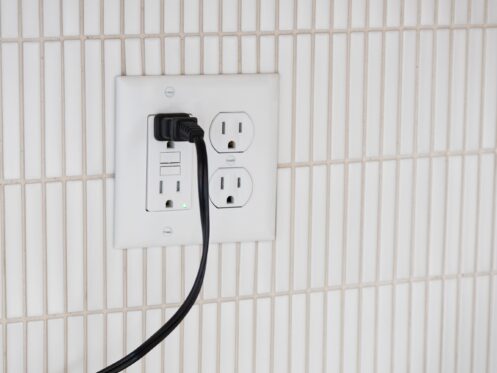
Modern electrical systems feature multiple types of safety technology meant to protect you and your property. Among them, GFCI and AFCI outlets are increasingly prevalent. However, you may not understand precisely what each does and when you’d need them. To clarify, the experts here at Monkey Wrench Plumbing, Heating, Air & Electric prepared this overview. It will help you know when you need a GFCI installation or an AFCI installation to ensure electrical safety.
What is a GFCI Outlet?
GFCI stands for Ground Fault Circuit Interrupter. To understand what that means, know that electricity flows through a standard grounded outlet. Put simply, electrical current travels in a circular path from the source to each outlet and back. A grounded outlet requires three wires: hot, neutral, and ground. The hot wire carries electrical current from your electrical panel to the outlet. The neutral wire provides a return path for the current when the outlet is in use. The ground wire serves as a neutral fallback. It provides a safe return path for the current if it is prevented from reaching the neutral wire.
A ground fault occurs when current flowing through an outlet takes an unintended path to ground. In other words, it means that power is not reaching either the neutral or the ground wire. That condition is often a result of the outlet or something attached to it getting wet. In that situation, you could receive a serious shock if you came in contact with the electrified water. A GFCI contains circuitry that can monitor current flowing through the circuit. If that circuitry detects a voltage difference between the hot and neutral wires, it instantly disconnects power. Their reaction time typically ranges between 20 and 60 milliseconds, which is quick enough to prevent electrocution.
Modern GFCI outlets owe their existence to research led by Charles Dalziel at the University of California. He conducted tests on volunteers to determine the current at which a person would be unable to “let go” of an electrical current source. In other words, he determined the point at which an electrical jolt moved from a simple shock to an electrocution. Using the threshold he determined through the research, Dalziel subsequently designed and patented the first GFCI that could disconnect a circuit quickly enough to prevent electrocution.
Are GFCIs Required?
Current electrical codes require GFCI outlets in multiple areas of your home. These locations include:
- Bathrooms
- Bathtubs and shower stalls
- Kitchens
- Garages
- Crawlspaces
- Basements
- Laundry areas
- Other damp or wet indoor locations
What is an AFCI Outlet?
AFCI stands for Arc-Fault Circuit Interrupter. An arc fault occurs when electrical current jumps from a wire or fixture to another metal surface. When that happens, an arc of electricity forms between the two. Electrical arcs are a significant cause of structure fires because they create intense heat that can ignite nearby flammable materials. Typically, electrical arcing occurs due to damaged wiring or electrical fixtures. It is also a common issue caused by worn-out or damaged electrical cords. Those are precisely the sources of the arc faults against which an AFCI outlet protects a home.
An AFCI contains circuitry capable of monitoring the sine wave of an electrical current. Arc faults produce specific kinds of disturbances in a current’s sine wave when they occur. When the pattern deviates from normal, the AFCI disconnects power to the outlet. Unlike GFCIs, AFCI devices are a far more recent innovation. They’re the brainchild of an R&D company called Zlan and its engineer, George Spencer. Their first AFCI devices date back to the 1980s, and the National Electrical Code (NEC) didn’t require them until 1999.
Are AFCIs Required?
Current electrical codes require AFCI protection in multiple spaces in your home. They include:
- Kitchens
- Dining rooms
- Living rooms
- Dens
- Bedrooms
- Sunrooms
- Recreation rooms
- Closets
- Hallways
- Laundry areas
- Similar areas
For all intents and purposes, it’s easier to understand the current code guidelines by listing where you don’t need AFCI protection. The code does not require AFCI protection in bathrooms, garages, or outside. In addition to those places, the code requires AFCI protection.
Understanding National Electrical Code Requirements
The NEC didn’t always mandate the installation of GFCI or AFCI in homes. Additionally, even when it did, the requirements were rather limited in scope. The mandated locations listed above reflect the code requirements in 2023.
You should also know that the NEC doesn’t require you to upgrade your home to include GFCI and AFCI protection in the listed locations. However, it does require that you add the necessary protection if you’re altering outlets or wiring in those places for any other reason. So, if you’re having a circuit or your whole home rewired, you will likely need to install GFCI and AFCI outlets to remain code-compliant. It’s worth noting that some circuit breakers also include GFCI and AFCI protection. They can be a more cost-effective way to upgrade your home when you’re making large-scale changes to its electrical system.
Signs You Need an Electrician for GFCI and AFCI Issues
If your home already has GFCI and AFCI outlets installed, you must test them regularly. If any of your outlets fail their self-tests, you need an electrician to replace them. Also, you may need an electrician’s help if your GFCI or AFCI outlets behave erratically. Occasionally, these outlets can malfunction even while passing their self-tests. You should also know that certain types of appliances and electrical conditions can cause GFCI or AFCI outlets to trip when there’s no danger. Our electricians can find the source of any problem and correct it.
You would also need an electrician’s help if you want to add new GFCI or AFCI outlets to your home. You can choose to do so to improve your home’s safety, or it can be as part of a larger electrical renovation. In most cases, you will need GFCI or AFCI outlets installed when upgrading your home’s electrical panel. Replacing your electrical panel would trigger the code requirements for any necessary GFCI and AFCI outlets. If you neglect those upgrades, your home may not pass its electrical inspection afterward.
Book GFCI or AFCI Outlet Installation with Monkey Wrench Plumbing, Heating, Air & Electric
Monkey Wrench Plumbing, Heating, Air & Electric has been the go-to provider of GFCI and AFCI installations in Los Angeles, CA, since 1999. We’re a family-owned and -operated business serving homeowners throughout the area. We stand behind every repair or upgrade we perform with an ironclad workmanship guarantee. If there’s a problem with our work, we’ll fix it immediately at no charge.
For proof of the quality of our work, look no further than our long list of five-star customer reviews, or consider that we’re a Better Business Bureau-accredited business with an A+ rating.
When you need GFCI or AFCI outlets installed to ensure the electrical safety of your Los Angeles home, contact Monkey Wrench Plumbing, Heating, Air & Electric.